
Hamilton Township Previous Residents by Era
Past residents leave different kinds of records at different times. Start with the current street address, but move quickly to the block-lot-qualifier or legal description when the trail gets older. A mailing address, taxpayer, recorded owner, household member, and newspaper subject may be different people. The table helps choose the next source without turning one historical mention into a claim of continuous residence.
| Source | Years it covers | Where held | What it shows |
|---|---|---|---|
| Atlantic County Clerk recorded-document search | Modern images strongest from March 1, 2000; older imaging varies | Online Clerk search and Clerk records access | Recorded deed parties, document and recording details, book/page, and linked instruments |
| Atlantic County deed indexes and deed books | 1837-1900 | New Jersey State Archives, 154 microfilm reels | Grantor and grantee index paths and deed-book coverage |
| Atlantic County wills | 1837-1921 | Atlantic County Library digitized collection | Name and family or estate leads |
| Local newspaper runs | Title-specific nineteenth and twentieth century spans | Library digitized collection, microfilm, and reference resources | Dated notices, place names, and household clues |
| Historic maps | 1891, 1896, 1906 reference, and 1948 confirmed anchors | Rutgers, Princeton, and National Park Service collections | Street, landmark, district, and footprint context |
For recent previous residents, begin with a current parcel key and the recorded instrument. For an older address or an address that has changed form, use the map and archival index before assuming a modern street search will find it.
Hamilton Township Past Resident Deed Trail
The Atlantic County Clerk recorded-document search is the primary public starting point for a Hamilton Township ownership trail. It supports party-name, second-party, document-group, date, book/page, file-number, and linked-document searches. The Clerk’s guidance also calls for spelling variations. Record both the deed date and recording date, because they describe different points in the transaction.
A property tax record or mailing address is not a substitute for title. The township assessor, tax map, and county GIS can identify the parcel and its B-L-Q, but the recorded instrument answers the title question. Follow the parties backward one conveyance at a time and retain the book/page or file reference for each stop.
- Use the address and assessor or map information to identify the parcel’s B-L-Q and legal description.
- Locate the current recorded deed in the Clerk search using the owner name, date, book/page, file number, or linked-document information.
- Read the prior party as a grantee in an earlier purchase, then locate that earlier deed.
- Repeat the process backward, checking name variants and recording the document type, deed date, recording date, and reference number.
- When the online image path no longer supplies a usable record, move to the State Archives deed-index guide, microfilm, or other documented local repository.
- Grantor and grantee
- The grantor transfers an interest in a recorded instrument. The grantee receives that interest. Their names provide the two directions for a deed-index search.
- Chain of title
- The linked sequence of recorded transfers for one parcel or legal description. It concerns title, not a complete roster of everyone who lived there.
- Legal description
- The parcel wording used in the recorded document. It can be more stable than a street address when street names or numbering differ over time.
Hamilton Township Resident Deed Indexes
The New Jersey State Archives Atlantic County deed guide identifies county clerk deeds and indexes from 1837 through 1900 on 154 reels. It includes separate grantor and grantee index sections and deed-book ranges. That documented coverage is especially useful when a current portal search reaches an older instrument without a dependable image or when the parcel’s later description needs to be carried farther back.
The State Archives research center is at 225 West State Street, second floor, Trenton, and lists access by appointment with walk-in service subject to space. Its broader collections include county records, state censuses from 1855 through 1915, federal census and special schedules, estate and will records, and other county material. Confirm a reel, book, and access procedure before making the trip, because an index entry is not the same as a copied deed page.
Index versus image. An index points to a recorded item. The document image, certified copy, or deed book is the source that reveals the actual recorded wording, parties, and parcel description.
Hamilton Township Previous Resident Address Maps
Previous residents research can stall when the source uses a river, rail, mill, courthouse, or schoolhouse landmark instead of a familiar street. Confirmed map anchors include 1891 Mays Landing maps in the Rutgers guide, Princeton’s 1896 May’s Landing Sanborn material, 1906 Sanborn evidence cited in National Park Service historic-district documentation, and the Rutgers or BTAA catalog record for a 1948 Mays Landing or Hamilton fire-insurance map.
Rutgers and BTAA’s catalog record for the 1948 map identifies a useful late-period reference for comparing a past address with its physical setting.
Compare the historic street, lot, river, rail line, or public landmark with a current tax map and the legal description in the deed. A Sanborn footprint or historic label helps locate the setting, but it does not prove ownership, occupancy, or current use.
Note: The research did not verify a 1931 Sanborn collection or a Hamilton-specific street-renumbering schedule, so neither should be assumed when evaluating an old address.
Pairing Hamilton Township Past Households
Ownership is only one part of an address history. To identify past residents, pair a confirmed address or person from the deed trail with dated household evidence. Exact Hamilton Township city-directory titles, publishers, year runs, and reverse directories remain unverified, so do not invent a volume or rely on an Atlantic City run as a substitute. The city directory collections page identifies the documented local shelves and that gap.
Federal and state census schedules can test whether a household was present near a particular period. A nearby directory year, if a local volume is confirmed, can bridge the interval. Newspapers can explain a marriage, estate, move, school connection, or local event. Each source should preserve its own date and address wording, because the same surname may appear more than once in the county.
- Choose a deed date or a map year as the anchor for the address trail.
- Look for a confirmed local directory or reference item near that date, while noting that no Hamilton run is currently established.
- Compare the name and place wording with the closest available census schedule.
- Search local newspapers for the same name plus a street, landmark, mill, courthouse, railroad, or school reference.
- Use a will, estate record, or later deed only to test the next historical connection, not to collapse several people into one household.
- Criss-cross directory
- An address-order directory section that can point from a street to a listing. Its availability for Hamilton Township is not verified and must be confirmed by the holding institution.
- Enumeration district
- The geographic area used to organize a census. It can help locate a household after the place and approximate date are established.
Hamilton Township Previous Residents Library Trail
The Mays Landing Resource Center keeps second-floor genealogy and Jerseyana resources with microfilm, reference assistance, databases, public computers, scanners, printers, newspapers, and other local material. The center is at 40 Farragut Avenue, Mays Landing, NJ 08330, phone 609-625-2776. Its posted hours are Monday through Wednesday, 9 a.m. to 8 p.m., and Thursday through Saturday, 9 a.m. to 5 p.m.
The Resource Center’s published page is the source for this library service and location.
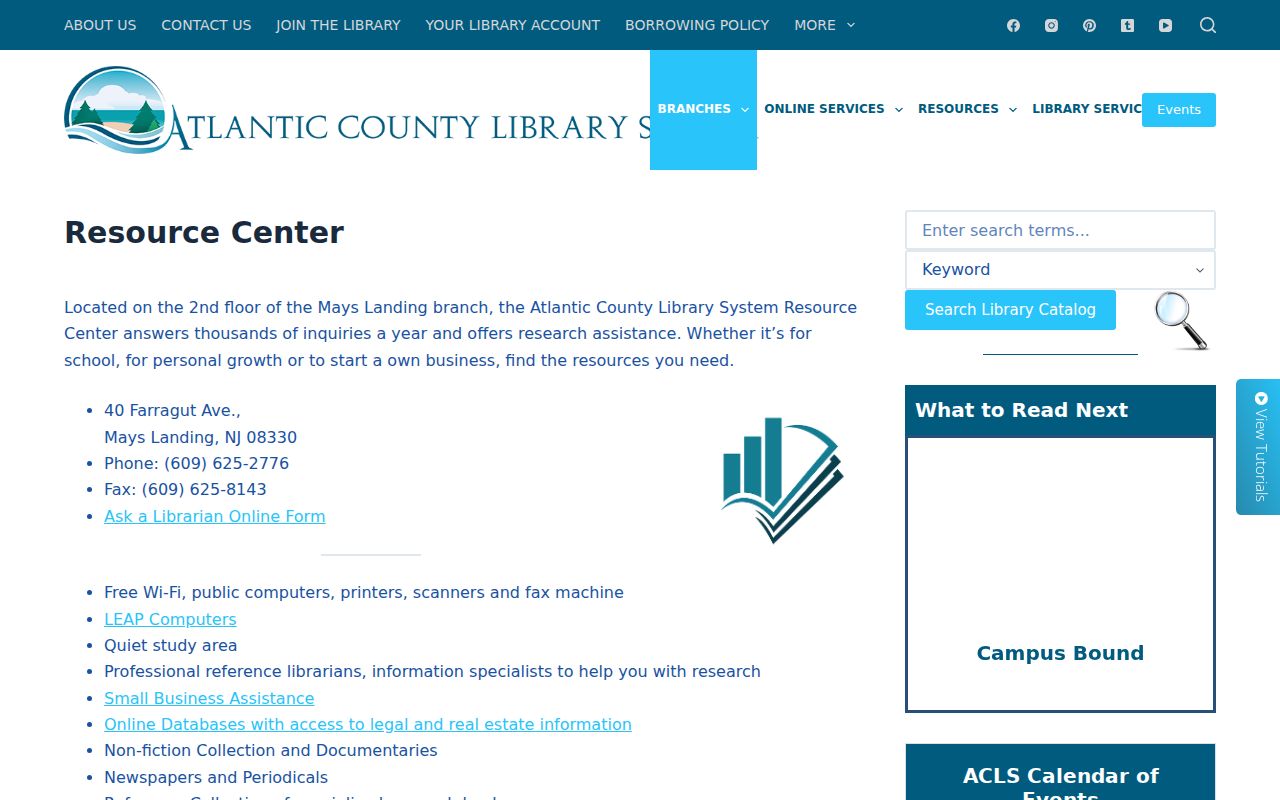
When digital newspaper search is being restored or a title does not appear online, the center’s microfilm and reference channels offer a documented fallback for researching former households.
Digitized newspaper spans include the Mays Landing Record, 1877-1906; Atlantic County Record, 1908-1917; South Jersey Republican, 1863-1923; and South Jersey Star, 1917-1923. A clipped reference still needs a date, page, and a second source before it becomes part of a past-residents conclusion.
Hamilton Township Resident History Context
Some historical households will appear near a river, mill, railroad, or county-seat landmark rather than in a clean street list. Hamilton Historical Society material describes shipbuilding near Babcock Creek, later Mays Landing Water Power Company and cotton-milling activity, railroad expansion, company residences, and the 1904 one-room schoolhouse. These place stories can provide search terms for historical newspapers and maps.
They are context, not proof of a person’s residence or ownership. The society’s account of an August 11, 1880 train disaster, for example, is a local-history lead that should be corroborated in period newspapers before being used for a family or address claim. Keep the source’s historic place label as written, then compare it with an official map and a recorded instrument.
Hamilton Township Previous Residents Limits
Research on previous residents is best kept to house history, family history, estate questions, and personal historical curiosity. A historical source is not a current location record. Do not use archival clues to track, threaten, or contact a living person, and do not publish protected details from a file or record.
Lawful personal use. New Jersey law addresses stalking and harassment, including N.J.S.A. 2C:12-10 and 2C:33-4. Use the trail to understand an address’s history, not to target anyone. Official suppression and confidentiality rules can limit what may be disclosed.
Daniel’s Law and New Jersey’s Address Confidentiality Program also protect certain address information. A deed, map, archival newspaper, or old directory-style lead must never be treated as permission to expose a current household location.